
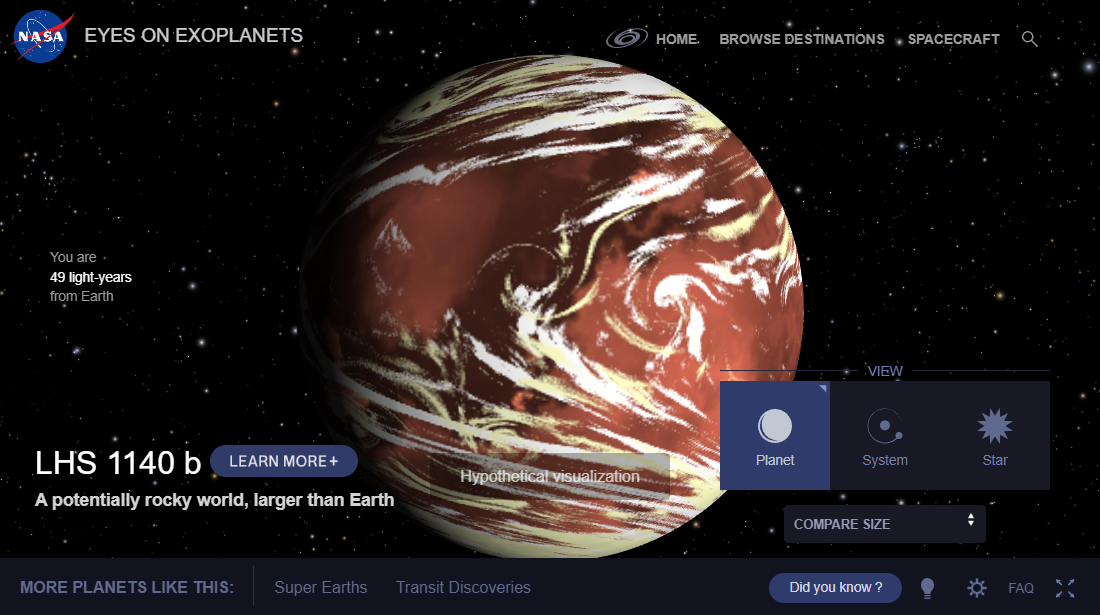
For decades, the search for life beyond Earth has rested on a single, frustrating gap in the evidence. Astronomers could find rocky planets orbiting their stars at exactly the right distance for liquid water to exist — the so-called habitable zone. What they could not confirm was whether any of those planets had managed to hold onto an atmosphere. Without one, the most perfectly positioned world in the galaxy is just an airless rock. On July 17, 2026, that gap closed for the first time. A Harvard-led team reported in the journal Science that LHS 1140 b — a super-Earth (exoplanet) orbiting a red dwarf star 48 light-years from Earth in the constellation Cetus — shows helium escaping from its upper atmosphere, confirming the planet retains a real, persistent atmosphere that has survived for more than three billion years.
The finding does not confirm life. It does not even confirm liquid water. What it confirms is that a rocky planet in the habitable zone of another star can hold onto its air — a question that has haunted planetary science for a generation and that, until this week, had no definitive answer.
What Was Found, and How
The detection required an unusual technique and an unusual piece of hardware. The team used the WINERED spectrograph on the Magellan Clay telescope at Carnegie’s Las Campanas Observatory in Chile — observing LHS 1140 b as it passed in front of its host star and watching for the specific signature of helium in the planet’s upper atmosphere.
The physics behind this is elegant
When a planet transits its star — crossing between the star and Earth from our vantage point — some of the starlight filters through the outer edges of the planet’s atmosphere before reaching our telescopes. Different atoms and molecules absorb light at precisely defined wavelengths, leaving a chemical fingerprint in the spectrum. Helium, when energized by stellar X-rays and ultraviolet radiation, absorbs light at a very specific near-infrared wavelength: 10,833 angstroms, corresponding to a triplet of lines produced by metastable helium — the quantum state helium atoms enter after being ionized and recombined by stellar radiation.
The team observed LHS 1140 b during a 6.5-hour transit window in 2024 and detected helium escaping from the planet’s atmosphere — a result lead author Collin Cherubim and his colleagues described as stunning. “This was clear evidence of an atmosphere on a habitable-zone exoplanet,” said Carnegie Science astronomer Shreyas Vissapragada, one of the co-authors. “It was an absolute thrill to see the transit spectra and slowly realize the implications of what we were looking at.”
What happened next added a layer of scientific intrigue
When the team repeated its observations at the next available transit window in 2025, the helium signal was gone. The atmospheric escape appears to be variable — present during one transit, absent during the next. Rather than undermining the result, this variability strengthens it: a spurious signal would not behave this way. Real atmospheric escape, driven by the variable output of stellar X-rays, would. The 2024 detection validated the observational approach; the 2025 non-detection demonstrated that the technique is sensitive enough to pick up real changes in escape rate.
Why the Exoplanet LHS 1140 b, and Why Now
LHS 1140 b is not a random target. It has been one of the most intensively studied exoplanets in its category for years, and the reasons for that focus tell a story about how the field has evolved.
The planet is located about 48 light-years away in the constellation Cetus. Its host star, LHS 1140, is a red dwarf roughly one-fifth the size of the Sun. LHS 1140 b orbits that star every 24.7 days — close enough to receive about 43% of the irradiation Earth gets from the Sun, placing it comfortably within what astronomers call the Water Condensation Zone, where temperatures could allow liquid water to exist on a planetary surface.
Estimates based on accumulated data from the Spitzer, Hubble, TESS, and James Webb Space Telescopes reveal that LHS 1140 b is less dense than expected for a rocky planet with an Earth-like composition, suggesting that 10 to 20% of its mass may be composed of water. A 2024 JWST study led by Université de Montréal astronomer Charles Cadieux found hints of a nitrogen-rich atmosphere potentially similar to Earth’s — leading Cadieux to describe LHS 1140 b as potentially “our best bet to one day indirectly confirm liquid water on the surface of an alien world beyond our solar system.” The July 2026 Science paper is the confirmation that those hints were pointing at something real.
The choice of a ground-based spectrograph rather than JWST for this particular detection is also significant. JWST operates in wavelength ranges that are powerful for detecting water, carbon dioxide, and methane at lower atmospheric altitudes — the molecules most directly relevant to habitability. The WINERED instrument on Magellan Clay operates in the specific near-infrared window where metastable helium is detectable. The Cherubim model can now be applied to other rocky planets in habitable zones to identify candidates likely to have detectable helium outflows — turning those planets into priority targets for the WINERED technique and, subsequently, for deeper space-telescope characterization.
In other words, the July 17 paper does two things simultaneously: it confirms LHS 1140 b has an atmosphere, and it hands astronomers a new tool for finding out which other rocky habitable-zone planets do too.
What Previous Searches Found — and Didn’t
To understand why this discovery matters, it helps to know what the years of searching before it produced.
The TRAPPIST-1 system — seven rocky planets orbiting an ultra-cool dwarf star 40 light-years away, three of them in the habitable zone — became the most celebrated exoplanet system of the 2020s precisely because of how many potentially habitable targets it offered in one place. JWST’s first atmospheric reconnaissance of TRAPPIST-1 b and TRAPPIST-1 c through eclipse photometry suggested both planets may be airless worlds — though the presence of atmospheres was not definitively ruled out. Subsequent JWST observations of other rocky exoplanets — including L 98-59 b, GJ 486 b, and several others in the intensive observation program— produced a consistent pattern: mostly airless worlds, or worlds where the atmospheric signal was ambiguous enough to resist confident interpretation.
Until now, data showing rocky exoplanets with atmospheres had been extremely limited, making it unclear whether these planets were capable of retaining their atmospheres long enough to enable life to arise and thrive. The null results from TRAPPIST-1 b and c, and the ambiguous signals from other candidates, had raised a genuinely worrying possibility: that rocky planets around red dwarf stars — which outnumber Sun-like stars in the galaxy by a factor of roughly ten to one — might routinely lose their atmospheres to stellar radiation, making habitable-zone worlds around these abundant stars systematically less promising than their orbital positions suggest.
LHS 1140 b’s confirmed atmosphere does not resolve that question definitively. But it establishes that at least one rocky habitable-zone planet around a red dwarf has held onto its air for billions of years — which means the category is not a dead end.
What Comes Next for the Exoplanet
LHS 1140 b is already part of a joint James Webb Space Telescope and Hubble Space Telescope observation prorgamtargeting rocky worlds around dwarf stars. The next observational phase will search for water, carbon dioxide, and other gases at lower altitudes, using transmission spectroscopy instruments that can reach into the planet’s lower atmosphere.
Lead author Cherubim suspects the inner atmosphere contains water and other small, oxidized molecules such as carbon dioxide — but this has yet to be verified with experimental data. Those verification observations are the next frontier, and they carry the highest scientific stakes in the program: carbon dioxide is a biosignature precursor; water vapor would confirm the planetary water inventory suggested by the density data; and the combination of both, in the right proportions, would make LHS 1140 b one of the most compelling targets for biosignature searches in the history of astronomy.
The James Webb Space Telescope’s transmission spectroscopy capabilities are well suited to exactly this follow-up. Previous simulations have shown that water, methane, and carbon dioxide could in principle be detected by JWST in the atmosphere of an Earth-like planet around LHS 1140 — and the confirmed existence of an atmosphere to look through makes those observations both possible and urgent.
The timeline for those results is measured in years rather than months. Transmission spectroscopy of a faint rocky planet around a dim red dwarf requires multiple transits, each 6.5 hours long, spread across observing windows that come around roughly every 24.7 days. Accumulating enough signal to confidently detect or rule out water vapour will take a sustained observational campaign. The field is patient. It has been waiting for this result for decades.
The Bigger Picture
This is the first exoplanet to be found with an atmosphere that is also in the habitable zone — meaning it is at the right distance from its star for liquid water to potentially exist on its surface. That sentence, unremarkable in its plainness, represents one of the most significant achievements in the history of planetary science.
The search for life beyond Earth has always been constrained by the question of whether the conditions for life could persist long enough to matter. Atmospheres are the medium through which those conditions operate: they regulate surface temperature, enable liquid water, protect against radiation, and — on Earth — carry the chemical signatures of biological activity that make remote detection of life theoretically possible at interstellar distances. A rocky planet without an atmosphere cannot do any of those things, regardless of where it sits relative to its star.
LHS 1140 b has an atmosphere
It has had one for more than three billion years. It sits in the zone where liquid water is possible. Its density suggests water may constitute a significant fraction of its mass. And it now has a confirmed observational program searching for the specific chemical fingerprints that would tell us something is happening on its surface beyond the purely geological.
None of that is confirmation of life. But it is the closest a rocky world beyond our solar system has ever come to ticking every box that makes the question worth asking.
Further Reading: Blue Origin’s Reusable Rocket: Is the New Space Race About to Get Cheaper?
Sources: Collin Cherubim et al., “Helium escaping from the atmosphere of a nearby rocky exoplanet orbiting in a habitable zone,” Science (July 17, 2026). DOI: 10.1126/science.aea9708; TechTimes (July 20, 2026); Phys.org (July 16, 2026); Daily Galaxy (July 16, 2026); Astrobiology.com (July 17, 2026); Nature News (July 17, 2026); Space.com (July 2026); University of Michigan News (May 2025); ScienceDaily / Université de Montréal (July 2024); arXiv: JWST TRAPPIST-1 observations; arXiv: LHS 1140 b Hubble WFC3 spectroscopy.