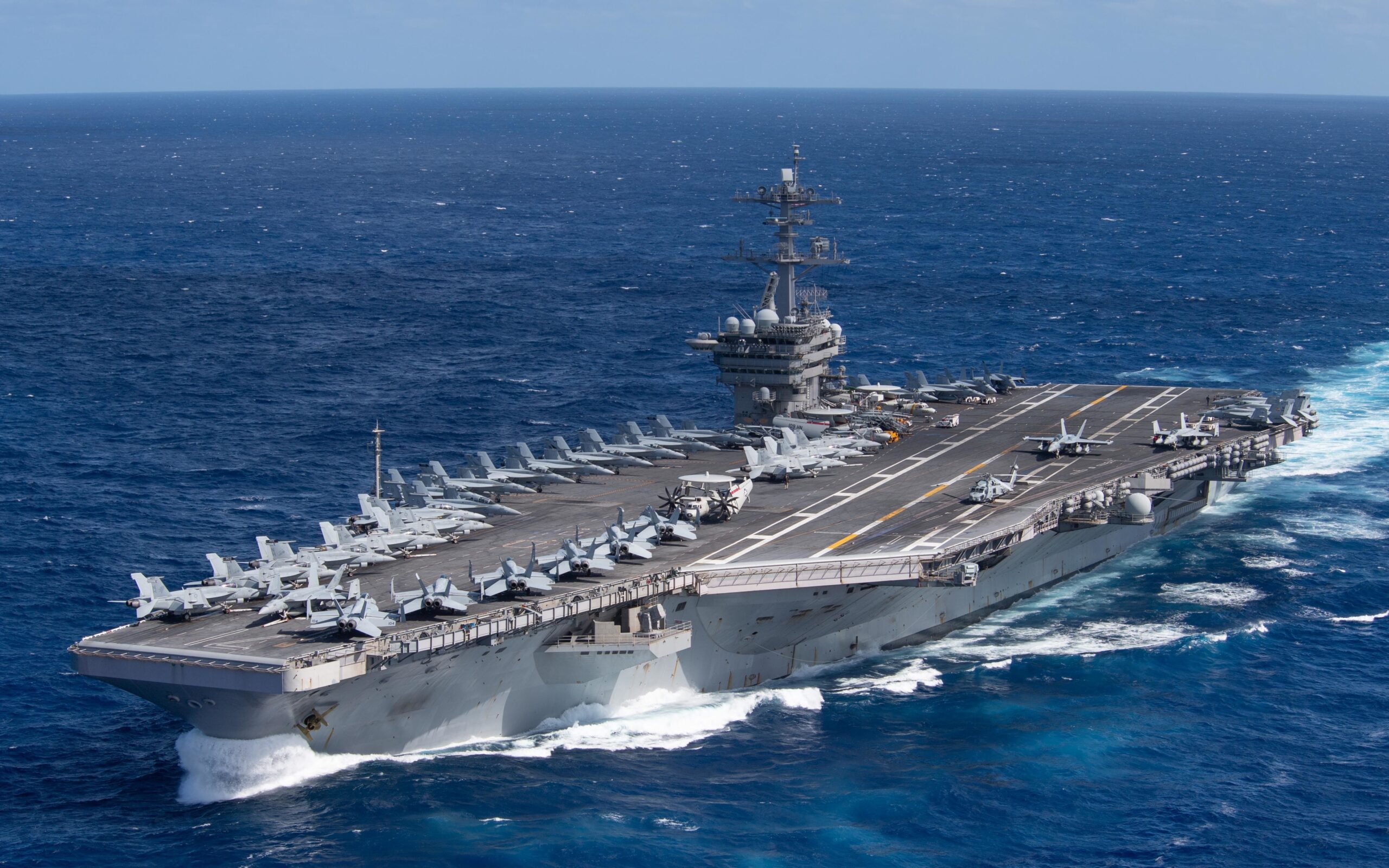
On October 1, the USS Theodore Roosevelt carrier strike group left its home port of San Diego bound for the Middle East. It was followed a day later by the Makin Island Marine Expeditionary Unit, carrying more than 2,000 Marines. By the time both groups arrive in theater in the first half of November, the United States will have three aircraft carriers, two amphibious ready groups, nearly 20,000 sailors and Marines, approximately 150 fighter jets, and a flotilla of guided-missile destroyers positioned in the waters surrounding Iran — the largest concentration of American naval power in the region since the 2003 Iraq War.
Iran’s response to the deployment was stated with unusual directness. A source in Tehran told The National on Saturday that Iran is preparing for a “major round of fighting,” even as diplomatic efforts in New York failed to produce a breakthrough last month. Iran’s Foreign Minister has said the US ambassador has not read Tehran’s latest proposal. The indirect talks that produced the June 28 ceasefire — which paused the direct exchange of strikes begun on February 28 — have stalled. And President Trump, who has described Iran as “ready to fold up,” has told aides he expects to resume bombing after the November 3 midterm elections.
Day 218 of the Iran war opened this week with the two sides simultaneously preparing for diplomacy and for escalation. The question that will define the next thirty days is which of those preparations matters more.
Further Reading: The U.S.–Iran Ceasefire: What the Strait of Hormuz Standoff Means for Global Oil
How the Conflict Reached This Point
The 2026 Iran war began on February 28, when the United States and Israel launched coordinated strikes on Iran’s nuclear and military infrastructure under the operation codenamed Epic Fury. The strikes followed the collapse of three rounds of negotiations in which, according to diplomats with knowledge of the talks, US negotiator Steve Witkoff undermined a potential deal by misrepresenting Iran’s offer to suspend uranium enrichment for several years in exchange for nuclear fuel supplies.
Iran’s retaliation was immediate and broad. Iranian missiles and drones targeted US embassies and military installations across the UAE, Saudi Arabia, Qatar, Kuwait, Bahrain, Iraq, Oman, and Jordan. NATO forces struck down Iranian drones and missiles near Turkey’s Incirlik Air Base. The Strait of Hormuz — which carries roughly 20% of the world’s energy supply — was blockaded by Iran in March, triggering Operation Project Freedom, a US-led naval effort to reopen the waterway that was complicated when Saudi Arabia denied US access to its airspace and bases, concluding that the operation was not well thought out and risked broader escalation.
Seven months later
Iran’s casualties have been severe: more than 6,000 military personnel killed, 190-plus ballistic missile launchers destroyed, 155 naval vessels destroyed or damaged. The humanitarian toll on Iranian civilians has been significant, with UN Office for the Coordination of Humanitarian Affairs reporting more than 3,400 civilians killed and 33,000 injured. US forces have suffered losses across multiple theater engagements, including the attacks on bases in Kuwait that prompted Trump’s first post-ceasefire warning of resumed strikes.
A June 28 agreement paused the direct exchange of attacks. It did not resolve the underlying dispute — Iran’s nuclear program, the disposition of its enriched uranium stockpile, or the management of the Strait of Hormuz — and it did not end the conflict’s secondary fronts, including renewed Hezbollah-Israel fighting and the escalating Houthi campaign in the Bab al-Mandab Strait that has added a second global shipping chokepoint to the crisis.
What Three Carriers Actually Signal
The deployment of the USS Theodore Roosevelt strike group is not a routine rotation. It is a deliberate signal, timed and calibrated to be read in Tehran, in allied capitals, and in the US domestic political context of a midterm election now four weeks away.
Three carrier strike groups represent a commitment of hardware and personnel that the US military cannot sustain indefinitely. The USS George Washington is currently in the Arabian Sea. The USS George H.W. Bush is in the Indian Ocean. The USS Theodore Roosevelt, en route from San Diego, will complete the triad in early November. Together with the Boxer and Makin Island amphibious ready groups — each carrying its own complement of Marines and landing craft — the assembled force represents an ability to conduct sustained, large-scale air operations against targets in Iran, to suppress Iranian naval and missile forces in the Gulf, and to land ground forces if the operation’s scope expands beyond air and missile strikes.
What’s the Purpose
The 82nd Airborne Division’s Immediate Response Force, based at Fort Bragg, was pre-deployed to the theater before the February strikes. With the carrier additions, total US forces in the Middle East now approach 50,000 — a figure that encompasses air, sea, land, and special operations components across multiple basing arrangements in countries that have varying degrees of enthusiasm for what they are hosting.
Trump’s public statements have been unusually explicit about the deployment’s purpose. He has told reporters Iran is “ready to fold up” and that action could resume after the midterms. Aides have told The Wall Street Journal he expects to resume bombing in November. The carrier deployment, timed to arrive in theater in the first half of November, is not ambiguous in its intended message: the US is positioning to strike, not to negotiate, and the midterm election timeline is the operational schedule.
Iran’s Diplomatic Offer — and Why It Has Not Been Accepted
Against the backdrop of US carrier deployments and resumed strike planning, Iran’s diplomatic posture is more complex than the “preparing for major fighting” headline alone suggests.
Iran has put a specific proposal on the table: the transfer of its 60% enriched uranium stockpile to a third party as part of a phased diplomatic road map. This goes beyond what Iranian President Masoud Pezeshkian had previously said publicly about diluting the stockpile and submitting the process to verification — it is a more concrete offer of physical separation from the most proliferation-sensitive material Iran currently holds.
The proposal has not been formally accepted or rejected by the United States. Iran’s Foreign Minister has said the US ambassador has not read it. The indirect talks that took place in New York in September did not produce a breakthrough, with multiple meetings failing to find common ground on what US negotiators characterized as the fundamental requirement — verified dismantlement of Iran’s nuclear program — and what Iranian negotiators characterized as an impossible demand that goes well beyond what was achievable in the 2015 JCPOA framework.
The gap between the two positions is not new. It was present before February 28, and the military strikes have not narrowed it. What has changed is the leverage distribution: Iran’s nuclear infrastructure has been degraded, its military has absorbed significant losses, its economy is under severe sanctions pressure, and its oil export revenue — the primary source of government funding — has been severely curtailed by US secondary sanctions and the Hormuz disruption. Iran’s willingness to offer the uranium transfer may reflect a negotiating position genuinely seeking a deal, or it may reflect a calculation that appearing to seek a deal while the US prepares to escalate serves Iran’s information environment goals. Both things can be true simultaneously.
The Midterm Variable
Trump’s explicit linkage of post-midterm military action to the November 3 election has introduced a political variable that complicates both the diplomatic track and the military planning.
If Republicans perform well in the midterms, Trump has signaled he will interpret that as a mandate for resumed strikes. If the results are mixed or unfavorable, the calculus may shift — though Trump’s public statements suggest he has not publicly tied his Iran policy to any electoral outcome other than timing. The three-carrier deployment, arriving in theater around election day, is positioned to give him a military option in a narrow window between the midterm results and the new Congress being seated in January.
For Iran, the midterm calendar is both an opportunity and a threat. The opportunity: a window of approximately four weeks in which the political environment in Washington may be less predictable than usual, creating space for a diplomatic offer that the administration, under domestic political pressure, might be more willing to consider. The threat: if the midterms produce a result that Trump reads as a mandate for action, the three-carrier force gives him the means to act rapidly on that reading.
Allied governments watching this dynamic — particularly the Gulf states whose territory and airspace are embedded in the US operational architecture — are navigating a situation where the US military’s stated intentions for November are explicit, the diplomatic alternative is real but unresolved, and their own exposure to the consequences of either outcome is significant.
The Global Stakes of What Happens Next
The Iran conflict’s impact on global markets has been among the most consequential aspects of its now seven-month run. WTI crude oil above $107, the US 10-year Treasury yield at a 19-year high of 5.135%, the Federal Reserve hiking into an oil shock, and the global bond selloff that has pushed German Bunds to their highest level since 2011 and French OATs to their highest since 2008 are all partially attributable to the risk premium embedded in markets by a conflict with no visible resolution date.
A resumption of full-scale strikes in November — bringing the conflict back to its February-through-June intensity level — would almost certainly push WTI above $120, with Brent following. The Strait of Hormuz, currently constrained but not fully closed, would face renewed pressure to close entirely. The shipping routes through the Bab al-Mandab, already disrupted by Houthi activity, would face simultaneous pressure at both ends of the Arabian Peninsula’s energy transit corridor.
Possible Resolutions
A diplomatic resolution — even a partial one that produced a verified pause in uranium enrichment and a formal reopening of the Strait — would have the opposite effect: removing $15 to $20 per barrel of war premium from the oil price, easing global inflation pressures, giving the Federal Reserve room to pause its tightening cycle, and stabilizing bond markets that have been moved significantly by energy-driven inflation expectations.
The distance between those two outcomes — resumed strikes at three-carrier scale, or a uranium-transfer agreement that begins a phased de-escalation — is the most consequential open question in global geopolitics today. The answer is expected within thirty days.
Further Reading: The Starlink Effect and the Failed May Ceasefire
Sources: Al Jazeera, “New Aircraft Carrier, 10,000 US Troops: Is the Iran War About to Escalate?” (October 2, 2026); CNBC, “U.S. to Send Third Carrier Group to Mideast as Trump Warns of New Iran Strikes” (October 2, 2026); UPI, “U.S. to Send Third Aircraft Carrier, More Troops to Middle East” (October 2, 2026); The National, “Iran Gearing Up for Major Round of Fighting With US, Says Source” (October 3, 2026); Euronews, “US Sends Third Carrier Group to Gulf in Biggest Buildup Since 2003” (October 1, 2026); EA WorldView, “Iran War 2026 Day 218 Update” (October 3, 2026); Euronews, “US Sends Third Carrier Group to Gulf” (October 1, 2026); CBS News, “Trump Says Iran Ready to Fold Up” (October 1–3, 2026); Wikipedia, “2026 Iran War”; Wikipedia, “Prelude to the 2026 Iran War”; Wikipedia, “Operation Project Freedom.”