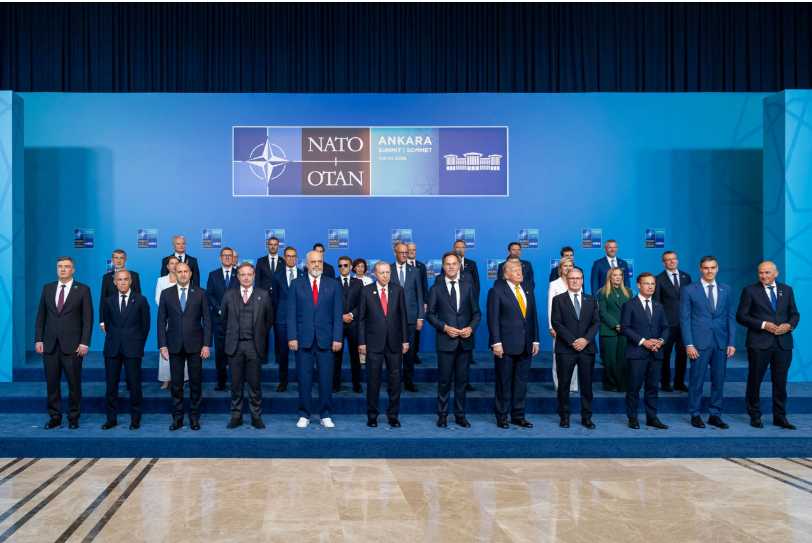
The 2026 NATO summit in Ankara is over, and the headline result is roughly what the alliance’s leadership scripted: a declaration reaffirming an “ironclad commitment” to collective defence under Article 5, a €70 billion pledge in military equipment, assistance, and training for Ukraine for 2026 with commitments to sustain equivalent levels in 2027, and a Trump who called the summit “very successful” before departing Turkey. On the surface, the alliance held.
Underneath the surface, the summit exposed a NATO that is being fundamentally restructured — not through any single dramatic rupture, but through the steady accumulation of pressure, unilateral announcements, and strategic repositioning that has defined US-European relations since January 2025. As one NATO diplomat put it ahead of the meeting, the summit would be “informed by several months of upheaval.” Two days in Ankara did not resolve that upheaval. They documented it.
The “First Report Card” — and What It Showed
Conservative analyst Luke Coffey of the Hudson Institute described the Ankara gathering as the “first report card” after last year’s summit in The Hague, where allies committed to spending 5% of GDP on defence by 2035, including 3.5% on core defence and 1.5% on broader security needs. By that measure, most allies showed up with passing grades — and the numbers were designed to say so.
Ahead of the summit, Secretary General Mark Rutte highlighted that European allies and Canada collectively spent an additional $1.2 trillion on defence over the past decade, including a 20% increase of $139 billion between 2024 and 2025 alone — and that for the first time, all 32 NATO members met the 2%-of-GDP benchmark in 2025, compared with just three allies in 2014. At the Defence Industry Forum running alongside the summit, NATO announced a commitment to invest $40 billion in counter-drone capabilities over the next five years, more than $26 billion in integrated air and missile defence, and $1.6 billion in new strike capabilities — with contracts spanning US companies including Lockheed Martin, Raytheon, Palantir, and Anduril alongside European firms including Germany’s Rheinmetall, France’s Airbus, Sweden’s Saab, and Turkey’s Aselsan.
Rutte had prepared for the meeting carefully, presenting Trump with large charts in an Oval Office meeting last month showing what he called “The Trump Trillion” — the aggregate increase in allied defence spending that Trump’s pressure had driven since 2017. Trump, who had told reporters in June that he was only attending because Erdogan was hosting — “If the summit was not taking place in Turkey, I don’t think I would have gone to it” — arrived to find an alliance that had done its homework. Trump confirmed at his closing press conference that allies were “making great progress” toward the 5% target and praised “tremendous unity” at the summit.
The passing grade, however, came with caveats that the spending figures alone don’t capture.
“NATO 3.0”: Burden Sharing Becomes Burden Shifting
The conceptual framework the Trump administration brought to Ankara is more ambitious than any previous American position on burden sharing — and its implications for the alliance’s architecture are only beginning to be absorbed.
The strategy, which administration officials have labelled “NATO 3.0,” was outlined earlier this year by Elbridge Colby, US undersecretary of defence, and envisions an alliance in which Europe takes on the majority of its own security needs, freeing Washington to shift focus and resources elsewhere. As ECFR senior policy fellow Ulrike Franke put it: “This is really the NATO summit where NATO goes from burden sharing to burden shifting.”
The distinction is significant. Burden sharing — the long-running American demand that allies pay more — leaves the fundamental structure of the alliance intact: the US remains the primary guarantor, Europeans pay a larger share of the bill. Burden shifting means something different: a genuine transfer of strategic responsibility for European security to European institutions, with the United States progressively repositioning toward other theatres, primarily Asia.
NATO has been structured around US power for 77 years, making this as much a political question as a military one, according to CSIS director Max Bergmann. Council on Foreign Relations senior fellow Liana Fix put the operational reality plainly: most of Europe remains far from being able to defend itself without the United States, “even if they’re starting to develop all that.” The spending commitments made at Ankara represent the beginning of a process that, on realistic timelines, will take a decade or more to translate into deployable military capability — and the Trump administration has not signalled patience for a decade-long transition.
The Pentagon’s announcement of a six-month review of US force levels in Europe — made before the summit, without coordination with allies — was the sharpest recent expression of that impatience. European allies and Canada will want reassurances, or at least clarity, on US force intentions, having often been blindsided by Trump’s declarations on troop cuts. No such clarity emerged publicly from Ankara.
The Iran Fault Line
The off-agenda issue that most complicated the summit’s unity message was the one most carefully kept off the official programme: European anger over the US-Israel military campaign against Iran and its aftermath.
Trump had publicly denounced European governments as “cowards” and called the alliance a “paper tiger” after Spain and Italy denied access to military bases for US personnel involved in the Iran operation. Germany and eventually the UK did grant certain basing rights, but the episode exposed a deep fracture over allied obligations when US military action is not collectively sanctioned. European allies had declined Trump’s requests to assist in protecting shipping lanes through the Strait of Hormuz — a refusal that triggered Trump’s heightened public criticisms of NATO in March 2026, and that had not been fully resolved before leaders arrived in Ankara.
Trump singled out Spain for particular criticism at the summit, calling Madrid a “terrible partner in NATO” — a public rebuke with few modern precedents at a summit meant to project alliance solidarity. Spain’s refusal to grant basing rights during the Iran campaign appears to have been the specific trigger, though Spanish defence spending — one of the lower figures in the alliance — has been a persistent secondary irritant.
The Iran fracture matters beyond the immediate diplomatic bruising because it exposes the gap at the heart of NATO 3.0’s logic. If Europe is to take greater responsibility for its own security, it needs greater agency in determining when and how that security is engaged. The Iran episode demonstrated that the current framework still asks European allies to support US military operations they had no role in designing — and that refusing to do so carries real costs to the relationship. No alliance document resolves that tension.
Ukraine and the Turkey Sidebar
On Ukraine, the summit delivered its largest-ever annual financial commitment — €70 billion for 2026, with pledges to sustain equivalent levels in 2027 — and a declaration of unwavering support. European allies and Canada now fund approximately 90% of Ukraine’s air defence needs, a structural shift that represents the most concrete expression of burden shifting already achieved.
Ukraine’s battlefield position added unexpected optimism to the discussions. CSIS defence analyst Seth Jones noted that “the data indicates the Russians are performing terribly in 2026,” citing rising casualty rates and loss of ground, while Kyiv has stepped up long-range drone and missile strikes inside Russia targeting energy, military, and logistics infrastructure. German Foreign Minister Johann Wadephul stated Ukraine “more or less” has the upper hand in the conflict. Zelenskyy met with Trump on the sidelines and posted that the two had discussed “ideas that could strengthen our positions and bring peace closer.” Trump told reporters he believes both sides “want to make a deal” and hopes it is settled soon.
The summit’s most-watched bilateral was the Trump-Erdogan meeting, which produced announcements of a different kind. Trump stated that sanctions against Turkey — imposed over Ankara’s purchase of Russian S-400 military equipment — would be lifted, and that a decision on selling F-35 jets to Turkey would be made during the summit. By the closing press conference, Trump had pulled back slightly, saying he had not “totally made up my mind” on the F-35 sale but that his inclination was favourable given how much Erdogan “has helped us in so many different ways.” Israeli Prime Minister Netanyahu had openly opposed the sale in a Fox News interview the day before, calling it a threat to place advanced weapons in the hands of a government hostile to Israel — a lobbying effort that may have contributed to Trump’s visible hedging.
What the NATO Ankara Summit Settled and What It Didn’t
The Ankara summit settled the question of whether the alliance would visibly fracture under its accumulated pressures. It didn’t, at least not in Ankara. The final declaration includes an Article 5 commitment signed off by all 32 allies, and Erdogan called the summit “historic.”
What it did not settle: the pace and depth of US military disengagement from Europe; the rules governing allied participation in US-led military operations outside Europe; the F-35 decision and its diplomatic ripples; and the longer-term question of whether European defence investment can actually produce the autonomous military capability that NATO 3.0 assumes is coming.
The defining transition the summit formalized is from burden sharing to burden shifting — from asking Europe to pay more for American security guarantees toward asking Europe to provide its own. That is a more honest framing of where the alliance is heading. Whether Europe can get there on a timeline the United States finds acceptable — and whether Washington will stay engaged while it tries — remains the open question that no summit declaration can answer.
Sources: NPR; CNBC; Euronews; Al Jazeera (live blog, July 7–8, 2026); Foreign Policy / Situation Report (July 7, 2026); Foreign Policy (Ankara Summit Declaration full text); Congressional Research Service, “NATO: Issues for the July 2026 Ankara Summit”; PBS NewsHour; The Jerusalem Post; ABC13/AP. Featured Image Credit: NATO.