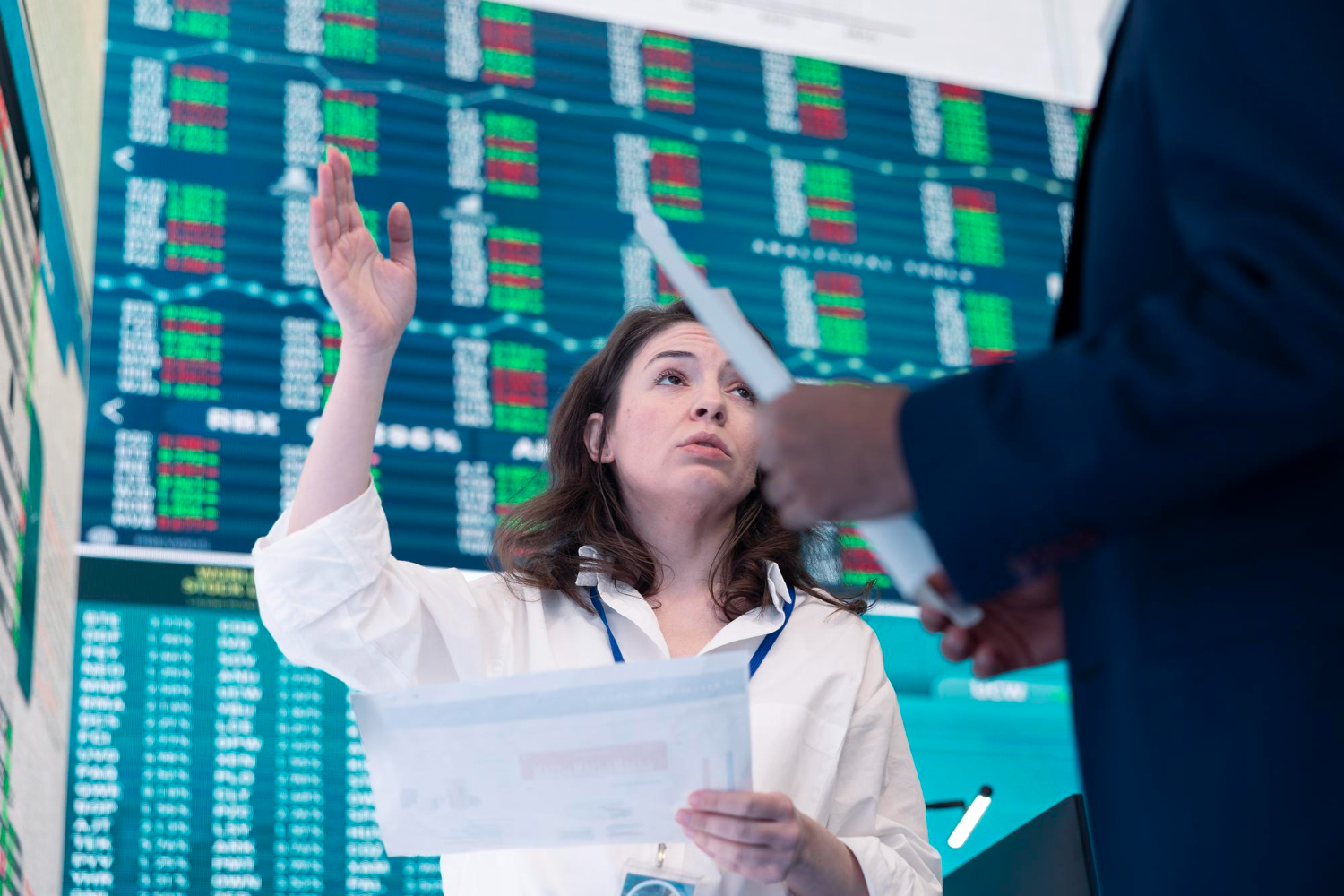
Donald Trump and Xi Jinping sat down to a state dinner at the White House on Thursday evening. The 10-year US Treasury yield climbed to 5.135%, its highest level since July 2007. Thirty-year yields reached a 22-year high. WTI crude oil closed above $107 per barrel, up 27.4% in a single month. The S&P 500 fell for the third consecutive session. Selling hit ten of eleven S&P 500 sectors. Only 29% of index stocks are trading above their 50-day moving averages.
The juxtaposition of a lavish diplomatic summit and a collapsing bond market captures something true about the current moment. Geopolitical theater is running on one track, and the financial conditions trajectory is on another. The two tracks are increasingly difficult to reconcile in a single coherent investment narrative.
The trade truce extension, agreed between Treasury Secretary Scott Bessent and Chinese Vice Premier He Lifeng, paused mutual tariffs. However, it landed in a market absorbing a 19-year bond yield high. Another Fed official called for a second October rate hike. Oil has damaged global financial conditions more in thirty days than any diplomatic agreement can undo.
Further Reading: Brent Crude Just Broke $100. The Fed Meets in Five Days
What Drove the Treasury Yield to a 19-Year High
The bond market’s move to 5.135% on the 10-year is not the product of a single day’s data. This reflects the culmination of a sequence running since the Fed’s September 16 hike. The accelerants this week were specific and identifiable.
Wednesday’s September S&P Global US Manufacturing PMI came in above expectations, triggering an immediate Treasury sell-off. A stronger-than-expected manufacturing print means the economy is not rolling over under the weight of $100-plus oil. September rate hikes remain on the table, which for bond markets implies the Fed has work to do. New York Fed President John Williams said Wednesday that the Fed would “likely need to hike again this year.” Fed Governor Michael Barr said Thursday that “further policy adjustments are likely to be needed.” CME FedWatch now prices a 68% probability of another 25-basis-point hike at the October meeting — six weeks from now.
Weak auction demand has compounded the Treasury yield move
The mechanics are straightforward: the US government is borrowing heavily, AI companies have raised an estimated $1.5 trillion in corporate debt this year, crowding out primary dealer allocation for government securities, and the pool of buyers willing to absorb that supply at current prices is shrinking. When auction demand weakens, a rising clearing yield attracts buyers, and markets use that yield as the risk-free rate at which every other asset is priced worldwide.
Rising oil has added the final layer
WTI above $107 reflects renewed Middle East infrastructure risk — attacks on Saudi pipeline infrastructure drove a sharp spike earlier this week — on top of the persistent Hormuz disruption that has been in place since the Iran conflict began in February. Energy prices at these levels drive inflation expectations. Consequently, bond investors embed these expectations in the yield they demand. CPI prints will determine whether the Fed hikes again in October.
As Schwab’s Collin Martin put it Thursday: “I think the bond market is sending a message, but I think it’s saying that the economic backdrop remains relatively firm, inflation is still a concern, and interest rates may need to remain higher than investors previously expected. Global yields have risen as well, so it’s not just a US story.”
That last point deserves emphasis. Bond selloffs do not stay confined to Treasuries. UK gilts, German Bunds, and Japanese government bonds are under pressure. This signals a global repricing of the risk-free rate. Consequently, financial conditions tighten for every borrower and for all valuation models.
The Trump-Xi Summit: What It Delivered, and What It Didn’t
Xi Jinping’s arrival at Joint Base Andrews Wednesday evening — greeted personally by Trump on the tarmac in a gesture no US president had made for a foreign leader in six decades — set a deliberately warm diplomatic tone for a summit that analysts had pre-positioned as heavy on symbolism and light on substance. That framing proved accurate.
The concrete deliverable is the trade truce extension
The agreement reached between Bessent and He Lifeng pauses the tariff architecture that had pushed mutual US-China duties above 100% — extending the existing truce from its November expiration to January 10. People familiar with the talks said discussions could also include Treasury yield agreements to lower some specific tariffs, address drug trafficking, and expand military-to-military communications channels. Trump is expected to seek the release of Americans detained in China.
The AI dimension of the summit
Both sides agreed to study threats from advanced AI systems. The topic reached the White House agenda the same day Altman and Amodei briefed the UN Security Council. They framed their stance against Trump’s UN speech, which labeled international AI oversight as a globalist scheme.
For markets, the summit’s trade truce extension removes one source of tail risk. The risk is the prospect of tariffs snapping back above 100% in November. It does not remove the deeper structural tension in the US-China economic relationship. The tension includes supply chain diversification, rare earth export restrictions, and semiconductor controls. It has been reshaping global trade flows throughout 2025 and 2026. For the full context on how that realignment is playing out.
Former Deputy Secretary of State Kurt Campbell framed the summit’s limits plainly: “This is really the historical reincarnation of what we often referred to in antiquity as single combat — really powerful guys, each representing their civilizations, kind of measuring each other.” The metaphor is apt. The summit is a relationship management exercise between two powers whose structural competition has not paused for the banquet.
What $107 Oil Is Doing to the Global Picture
WTI crude at $107 is the single most important variable in global financial conditions right now — more consequential, in its day-to-day transmission to inflation and consumer purchasing power, than either the trade truce or the Fed’s stated intentions.
The arithmetic is direct. At $107 WTI, US retail gasoline prices are running above $4.50 per gallon nationally and significantly higher in coastal markets. Every dollar of gasoline expenditure above the consumer’s planning assumption is a dollar not available for discretionary spending — and the consumer spending that accounts for roughly 70% of US GDP is showing strain. Third-quarter earnings season, which begins in earnest in two weeks, will be the first opportunity to see how corporate margins have absorbed the summer’s energy price surge. Airlines, chemicals, shipping, agriculture, and every energy-intensive manufacturer are exposed.
The Saudi pipeline attack that accelerated this week’s move compounds the Hormuz disruption that has been in place since February. OPEC+ has signaled it views Gulf supply disruptions as force-majeure conditions outside its production management framework. There is no coordinated supply response on the horizon. The $107 floor is being tested from below rather than above — which is to say, the path of least resistance in oil, absent a diplomatic breakthrough on Iran or a material demand-destruction signal, is higher rather than lower.
The October Fed Decision: Now 68% Probability
Six weeks ago, the September Fed hike was the market’s primary focus. That hike landed September 16, raising the federal funds rate to 3.75%–4.00% — its first increase in three years. The market had expected the September hike to be a one-and-done adjustment, with the dot plot showing a pause before any further action.
The dot plot did not cooperate, and neither did the data that followed
With the October meeting now priced at 68% probability of another 25-basis-point hike, the Fed is on track to raise rates twice in consecutive meetings — a pace that, combined with $107 oil and 5.135% on the 10-year, represents the most aggressive simultaneous tightening of financial conditions since 2007. The comparison is imprecise — the banking system is far better capitalized, the shock is supply-side rather than credit-side — but the directional echo in asset prices is becoming harder to dismiss.
Barr’s comment Thursday — that “further policy adjustments are likely to be needed” — is the clearest signal yet that the September hike did not resolve the Fed’s inflation problem. The August CPI core reading of +0.3% was above consensus. September CPI, landing before the October meeting, will reflect the full impact of WTI above $100 for an entire month. If September core comes in above consensus again, the 68% probability will move toward certainty.
The Treasury yield curve
As of Thursday’s close: 2-year at 4.41%, 10-year at 5.135%, 30-year at the highest level since 2004. The curve’s positive slope is not reassuring in the current context — it reflects markets pricing in sustained higher rates across the entire maturity spectrum, not a short-cycle adjustment that will reverse when oil eases. Mohamed El-Erian, speaking at the Ambrosetti Forum in Italy, said Thursday he sees “continued upward pressure on yields” given the absence of any near-term fiscal consolidation appetite in Washington and said the US Treasury had “taken a step too far” with a recent market intervention. Investors should “expect the sell-off of global government bonds to continue,” he warned.
The emerging market implications of a 5.135% US 10-year Treasury yield deserve a specific word. Dollar-denominated borrowers across developing economies face a double pressure: their import bills for dollar-priced oil are rising, and their funding costs are rising simultaneously because the risk-free rate against which their credit spreads are calculated has moved to a 19-year high.
Where Markets Go From Here
The configuration entering the final week of September is the most restrictive global financial conditions environment of this entire cycle. The 10-year at 5.135% is a 19-year high. WTI at $107 is the highest since the early weeks of the Iran conflict. The Fed is on track to hike again in six weeks. The BOJ, having hiked in September, is under continued pressure to tighten further as the yen weakens past 157 against the dollar. UK and German sovereign yields are at multi-decade highs. Only 29% of S&P 500 stocks trade above their 50-day moving averages — a breadth reading that, in most historical contexts, precedes rather than follows the worst of an equity drawdown.
Against that backdrop, the Trump-Xi trade truce extension to January 10 is a genuine risk-reduction — it removes a November tariff shock from the calendar and gives both sides time for more substantive negotiations. But it cannot, by itself, reverse financial conditions that are tightening independent of trade policy, driven by energy prices, domestic labor market strength, and a debt supply pipeline that shows no sign of easing.
Current Treasury yield levels
Schwab’s Martin has argued that current yield levels are “not a problem that needs to be fixed” given the economic backdrop — a view that holds as long as the economic resilience it reflects does not tip into the recession that historically follows the combination of $100-plus oil and the most aggressive Fed tightening in two decades. History’s record on that last transition is not encouraging. The question markets are now genuinely asking — not as a tail risk but as a scenario with real probability mass — is whether the soft landing is still achievable, or whether the September and October hikes, landing into $107 oil, are the policy mistake that ends it.
October earnings season, the September CPI print, and the October 28-29 FOMC meeting will answer that question. Markets have approximately thirty days to find out.
Further Reading: Africa’s Debt Trap Reckoning: Which Countries Are Closest to Default
Sources: Charles Schwab, Market Update Open (September 24, 2026); CNBC Daily Open: “A Tarmac Welcome Buys US-China Truce a Longer Runway” (September 24, 2026); Reuters / Investing.com, “Trump Welcomes Xi to Washington Looking for a Trade Win” (September 24, 2026); Al Jazeera, “Trump-Xi Summit: Here’s What’s on the Agenda, and Why It Matters” (September 24, 2026); CNBC, “Trump, Xi to Talk Taiwan, AI, Trade and Iran as DC Summit Kicks Off” (September 24, 2026); Rio Times Online, “Global Economy Briefing September 24, 2026”; Yahoo Finance / 24-7 Wall St., “What Is the Best Crypto to Buy Before the Trump and Xi Meeting on September 24?” (September 22, 2026); T. Rowe Price, Global Markets Weekly Update (September 21, 2026); IMF WEO Update Press Briefing Transcript (July 8, 2026); Deloitte Insights, Weekly Global Economic Update (September 22, 2026); CME FedWatch Tool (September 25, 2026); FRED, US 10-Year Treasury Yield (September 25, 2026).