
On the evening of January 29, 2025, American Eagle Flight 5342, a regional Bombardier CRJ700 jet, was on final approach to Ronald Reagan Washington National Airport. A U.S. Army Black Hawk helicopter was operating simultaneously on Route 4, a low-altitude corridor running directly adjacent to the runway approach path. The two aircraft collided approximately half a mile southeast of the airport. All 67 people aboard both aircraft perished, marking the deadliest U.S. aviation accident in over two decades.
The National Transportation Safety Board spent a full year investigating. Its conclusion, delivered in January 2026, was unambiguous. NTSB Chair Jennifer Homendy described the outcome as the product of “deep, underlying systemic failures — system flaws — aligned to create the conditions that led to the devastating tragedy.” The FAA (the Federal Aviation Administration), she said, had collected reports of more than 80 serious close calls between helicopters and passenger aircraft in recent years. “The data was there. The data was in their own systems.”
The DCA collision was not a freak accident, it was a symptom. The most visible and deadly manifestation of a crisis that has been building inside America’s air traffic control system for more than a decade. Understanding that crisis, and what the FAA and Congress are now doing about it, is essential for anyone whose business depends on the reliability and safety of U.S. airspace.
The Numbers Behind the Crisis
The scale of the FAA’s staffing problem is not in dispute. The data is public, consistent, and damning.
As of early 2026, the FAA reports approximately 10,800 fully certified controllers on active duty against an agency target of roughly 13,800, a shortfall of around 3,000 positions, according to data presented to the House Transportation and Infrastructure Committee.
The facility-level picture is equally stark. As of September 2024, over 40% of the FAA’s 290 terminal facilities (e.g., the radar rooms and towers managing takeoffs and landings) were understaffed. 118 of them fell short of the FAA’s own 85% staffing threshold. The most understaffed facility in the country, Grand Forks Tower in North Dakota, operated at just 53.3% of its target controller level.
What makes this crisis particularly difficult to solve is the pipeline that is supposed to fix it. The Government Accountability Office confirmed in December 2025 that approximately 2% of all applicants ultimately become Certified Professional Controllers (CPC). The total time from application to full certification averages more than five years. Despite meeting or exceeding hiring targets every year since 2023, the FAA achieved a net gain of just 15 certified controllers in fiscal year 2023 and 108 in 2024. Despite aggressive recruitment, the net deficit remains stubbornly fixed between 3,500 and 3,800 controllers.
The system, as one aviation expert put it to General Aviation News, is “mathematically broken.”
How Did It Get This Bad?
The current crisis did not appear overnight. It is the compounded result of budget decisions, political failures, and institutional inertia across multiple administrations and Congresses.
In FY 2013, the government-wide sequester forced the FAA into a prolonged hiring freeze. Just as controller staffing was beginning to recover, a 35-day government shutdown in FY 2019 produced large hiring and training delays. Each interruption had a knock-on effect that lasted years, because training a certified controller is not a process that can be paused and resumed without cost.
The 2025 shutdown made things considerably worse. Controllers were required to work without pay, some took leave, and the agency cut schedules at dozens of airports to preserve safety. Shutdown contingency plans included furloughs for thousands of support staff and instructors, effectively freezing portions of the training pipeline. Industry coalitions and labor groups argue that every lost week at the academy in Oklahoma City translates into months of knock-on effects for staffing levels down the line.
Congress also blocked a direct solution. Proposals for a second controller training academy were rejected in Congress, despite warnings from safety experts and the FAA that a single campus could not rapidly produce the number of certified professionals the system required.
The funding gap is also measurable and well documented. The FAA Reauthorization Act of 2024, championed by Senator Maria Cantwell, authorized more than $105 billion in FAA appropriations for fiscal years 2024 through 2028, including $66.7 billion for FAA operations to fund key safety programs and enable the hiring, training and retention of safety-critical staff like air traffic controllers. Yet the gap between what was authorized and what was actually funded has persisted for years.
When reports emerged that FAA safety employees (including technicians working under the FAA’s Air Traffic Organization) were being fired as part of federal workforce cuts, Cantwell issued a direct warning: “Now is not the time to fire technicians who fix and operate more than 74,000 safety-critical pieces of equipment like radars, navigational aids, and communications technology. The FAA is already short 800 technicians and these firings inject unnecessary risk into the airspace.”
FAA Administrator Bryan Bedford put it even more directly in remarks to Federal News Network: “Between 2013 and 2023, the FAA only hired two thirds of the controllers that the FAA’s own staffing model called for. So today, we find ourselves short 3,500 air traffic controllers, while air travel rises to record highs and controllers are forced to regularly work 60-hour weeks because well over 90% of airports are understaffed. Placing the lives of our constituents in the hands of civil servants who are overworked and utterly exhausted was and remains unfair, unacceptable, and ultimately dangerous.”
When the System Breaks, People Die
The DCA collision did not happen in isolation. The warning signs were already documented, already filed, and already ignored.
On the night of the collision, the NTSB found that air traffic controllers felt “overwhelmed” with the volume of traffic. The Board determined that the increased workload led to reduced situational awareness and that this finding tied the reduced situational awareness not to individual error, but to system performance constraints at DCA.
Investigators found the FAA had failed to act on repeated internal warnings and data indicating a high risk of conflict between helicopters and fixed-wing aircraft in the area. The agency had been supposed to evaluate helicopter routes every year to ensure they remained safe, but produced no evidence that it had done so recently. “This shouldn’t have existed,” Homendy said of the airspace design.
The warnings were not limited to Washington. Confidential safety reports filed with NASA’s Aviation Safety Reporting System paint a system operating at its limits. A controller at Los Angeles Center, working a closing shift with 25 aircraft and just two people on duty, wrote: “I turned to my coworker and told him I was at a loss, I have no idea what to do with all these aircraft.” A pilot at LaGuardia Airport filed a report in August 2025 that ended with a direct warning: “The controllers are pushing the line. On thunderstorm days, LGA is starting to feel like DCA did before the accident there. Please do something.”
The human cost extends inside the workforce itself. A December 2024 study by Southern Illinois University Carbondale found that approximately 20% of active controllers suffer from moderate to severe anxiety, which is four times the rate in the general population. Controllers who seek mental health treatment face immediate grounding with no guaranteed timeline for return, a system the FAA’s own Mental Health Aviation Rulemaking Committee described as one that “disincentivizes honesty.”
What the FAA and Congress Are Doing — And Why It May Not Be Enough
The response from Washington has been significant. But the gap between stated ambition and structural reality remains wide.
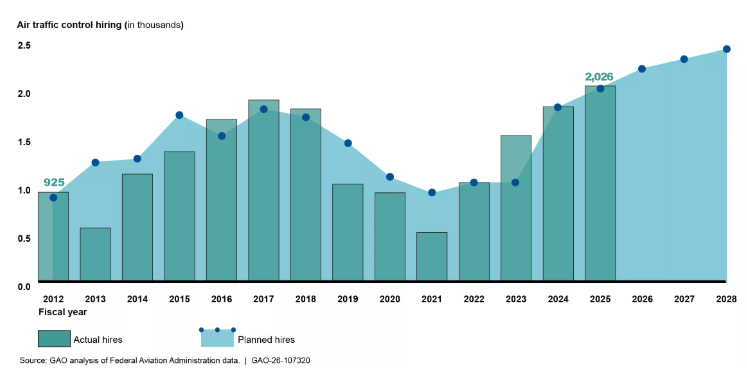
On the hiring side, the FAA plans to hire at least 8,900 new air traffic controllers through 2028, including 2,200 in FY 2026 and an estimated 2,300 in FY 2027. The agency has streamlined its hiring process from eight steps to five and raised student starting salaries by nearly 30%.
On the technology side, Congress passed a $12.5 billion investment in ATC modernization as part of the “One Big Beautiful Bill Act.” Since its approval, almost 50% of all copper wires in the air traffic control system have been replaced, approximately 270 radio sites were converted, and 17 towers started using electronic flight strips. Over 4,500 FAA sites are receiving new radars, digital voice switches and training simulators. But Transportation Secretary Sean Duffy has already said publicly that he needs an additional $7 to $10 billion for the software side of the upgrade and is back asking Congress for more.
For FY 2026, the spending package provides the FAA with a $22.2 billion budget, including a $235 million boost for the Air Traffic Organization, $824 million for facilities and equipment, and funding to hire 2,500 new air traffic controllers.
However the crisis is structural. Even with record hiring, attrition from retirements, promotions and departures continues to erase much of the net gain. The figures of 15 and 108 net new certified controllers in consecutive fiscal years (despite meeting hiring targets) make this brutally clear. As long as the pipeline produces certified controllers more slowly than the workforce loses them, the deficit persists.
House Transportation Committee Chairman Sam Graves has proposed shifting some controller training to collegiate aviation programs, which could shorten the Academy pipeline. In addition the FAA has significantly expanded its Enhanced Collegiate Training Initiative, a program that now includes 10 partner universities where graduates can bypass the FAA Academy and move directly to facility training. The National Air Traffic Controllers Association has consistently called for a universal curriculum and standardized oversight across all programs, warning that inconsistent standards between institutions create an uneven training pipeline.
Notably, the FAA funding bill signed into law in February 2026 explicitly prohibits the use of funds to plan, design, or implement privatization of the ATC system, a political signal, but not a solution to the staffing math.
What This Means for the Future of Flying
For aviation professionals and business travelers, the consequences of this crisis are already measurable and are likely to intensify.
The operational cost of the staffing crisis is already measurable at the flight level. Airlines for America documented that on a single day (November 12, 2025) airlines incurred more than 15,600 staffing-related delays and more than 7,100 staffing-related flight cancellations, with 99.8 percent of those cancellations directly attributable to FAA-mandated flight reductions at 40 airports. The agency is now heading into what is projected to be the highest-volume summer travel season in U.S. aviation history, with a workforce that remains approximately 3,000 positions short of its own certified staffing targets.
The LaGuardia warning filed in August 2025 (comparing conditions there to DCA before the collision) is not just alarming language. It is a documented, formal safety signal that the same structural conditions that produced the deadliest U.S. aviation accident in 24 years may exist at other high-traffic facilities. A fatal crash at LaGuardia in March 2026, where an Air Canada regional jet struck a fire truck on landing, is now under NTSB investigation with controller staffing among the factors being examined.
Peraton, the contractor tasked with upgrading the ATC system, has deployed artificial intelligence tools to identify risks before they escalate. “Risks are caught before they become crises,” said Justin Ciaccio, president of Peraton’s national aerospace solutions sector. “Tasks that used to take the team days or weeks are now complete in minutes or seconds.” Technology, however, does not replace the certified human controllers the system still needs.
Conclusion: A System That Warned Itself — and Wasn’t Heard
The NTSB’s most devastating finding about the DCA collision was not about the airspace design or the controller on duty that night. It was about institutional failure at the highest level. The FAA had the data. The warnings were filed. The near-misses were counted. And the agency did not act.
That pattern of documented risk, acknowledged warnings, and delayed response is the defining characteristic of this crisis. The question now is whether the billions of dollars flowing into the system, the record hiring targets, and the renewed political attention will translate into structural change fast enough to prevent the next preventable disaster.
For aviation and business professionals who depend on the reliability and safety of U.S. airspace, that question is not abstract. It is operational. And the honest answer, as of mid-2026, is that no one can yet say the answer is yes.