
The corner office, the gold watch, and the rigid 9-to-5 are no longer the aspirations of the modern workforce. As of mid-2026, Generation Z (born between 1995 and 2006) has officially crossed a critical threshold, now accounting for nearly 30% of the global labor pool. But they haven’t just entered the workforce; they have remodeled it.
For HR professionals and business leaders, the transition has been disruptive. The “Great Realignment” of the mid-2020s has shifted the power dynamic from transactional employment, trading time for a paycheck, to a relational model built on shared values, radical transparency, and digital fluency. Those failing to adapt are finding their recruitment pipelines dry and their turnover rates soaring.
Understanding the new rulebook isn’t just about “managing young people”; it is a requirement for operational survival in a post-digital economy.
Purpose Over Paycheck: The “Value-First” Filter
While every generation appreciates a competitive salary, Gen Z is the first to treat corporate ethics as a non-negotiable “hygiene factor.” According to the Deloitte 2024 Gen Z and Millennial Survey, nearly 44% of Gen Z employees have rejected a job or assignment because it did not align with their personal values.
The data suggests a decisive shift away from performative gestures. This generation increasingly scrutinizes the gap between a company’s public marketing and its internal operations. For many, a rainbow logo during Pride Month or a vague mission statement is no longer sufficient. Instead, they are looking for hard evidence in annual reports, such as audited carbon footprint data and concrete diversity statistics within executive leadership.
The Employer Pivot: Forward-thinking firms are moving toward Impact Transparency. By providing granular data on pay equity and environmental sustainability, companies are meeting the demand for radical honesty, a strategy that Gallup research indicates is essential for building trust with a generation that values authenticity above all else.
The Death of “Attendance-Based” Productivity
The 2025–2026 labor market has witnessed the definitive collapse of “productivity theater”, which is the long-standing corporate belief that physical visibility at a desk is a proxy for effective output. For HR leaders, the challenge has shifted from monitoring presence to measuring impact.
While Buffer’s 2024 State of Remote Work confirms that an overwhelming 98% of workers desire remote flexibility, Gen Z has pushed the requirement even further. They are moving beyond the where of work and into the when, championing asynchronous workflows that allow them to contribute during their peak cognitive hours.
Gen Z’s expectations for work are fundamentally different from previous generations. The data shows that they prioritize flexibility and autonomy as top requirements, viewing traditional, rigid schedules as a barrier to the high-trust, outcome-oriented environments they crave.
| Old Rule (The Legacy Model) | New Rule (The 2026 Mandate) |
| Attendance-Based: Success is measured by “time in seat.” | Outcome-Based: Success is measured by hitting KPIs, regardless of hours. |
| Annual Reviews: Feedback is a formal, once-a-year post-mortem. | Micro-Feedback: Real-time, continuous loops via Slack or AI-coaches. |
| Top-Down: Information is siloed and shared on a “need to know” basis. | Radical Transparency: Open-access documentation and public goals. |
| Linear Ladders: Growth means moving “up” the management chain. | Career Lattices: Growth means gaining diverse skills across departments. |
By replacing the “theater” of being busy with a framework of high-trust autonomy, businesses are seeing a direct correlation in retention. Gen Z doesn’t want to be managed; they want to be enabled.
The AI Paradox: Fluency vs. Anxiety
Perhaps the most significant rule being rewritten involves the role of technology. Gen Z is the first generation of “AI Natives,” yet they harbor a unique AI Paradox. While they are the most proficient at using generative tools to automate mundane tasks, they are also the most concerned about long-term job security.
Research from the Microsoft/LinkedIn 2024 Work Trend Index found that while 75% of knowledge workers now use AI, Gen Z users are specifically looking for employers who provide “AI-Human Co-piloting” training. They don’t want AI to replace their entry-level roles; they want AI to remove the drudge work so they can focus on high-level strategy and creative problem-solving.
What Leaders Are Doing: To bridge this gap, HR departments are implementing “Upskilling Stipends.” Rather than fearing AI, companies are incentivizing Gen Z employees to lead internal AI Task Forces, turning their natural digital fluency into a competitive advantage for the firm.
Solving the Retention Crisis: Mental Health as Infrastructure
The final rule Gen Z has rewritten is the definition of wellness. In the past, mental health was an afterthought, a brochure in the back of an HR manual. Today, it is a core business metric.
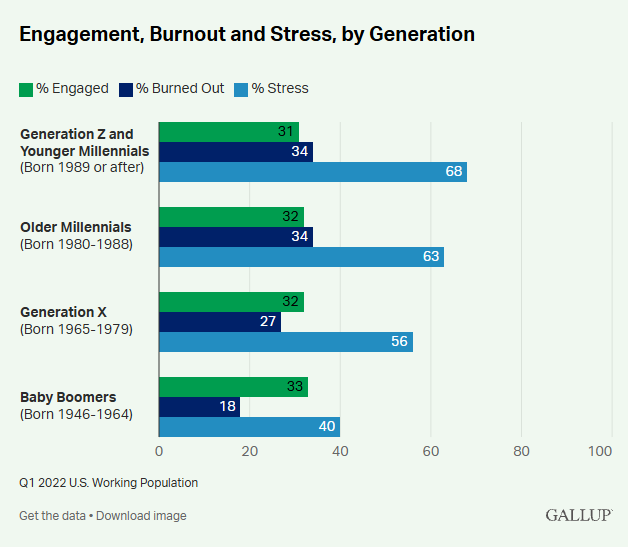
A 2024 Gallup report noted that Gen Z is more likely than any other generation to experience stress and burnout, partly due to the “permacrisis” environment of the 2020s. In response, employers are moving beyond “App-based therapy” to Structural Wellness:
- Four-Day Work Weeks: Once a radical experiment, now a mainstream retention tool for high-burnout industries.
- Preventive Mental Health Days: Encouraging time off before a breakdown occurs.
- Manager EQ Training: Training leaders to lead with empathy rather than just authority.
In Practice: How EY Is Betting on Gen Z
Understanding the new rules is the first step. Seeing them applied at scale is where the real lessons begin.
Ernst & Young, one of the world’s largest professional services firms, offers one of the clearest case studies available. At EY, 127,000 employees (nearly a third of the entire workforce) are from Generation Z. That number has tripled in just three years, bringing the median age of the EY workforce down to 30.
Rather than treating this demographic shift as a management challenge to be contained, EY has framed it as a strategic signal. The firm publicly acknowledges that Gen Z values (community, a global mindset, authenticity over polish, and the so-called “side hustle” mentality) are now driving workplace culture across all generations within the organization, not just among its youngest employees.
The lesson EY draws from its own data is instructive for any business leader watching their recruitment pipeline: Gen Z does not simply join an organization and adapt to its existing culture. They reshape it and the firms that recognize this early are the ones building the most resilient workforces for the decade ahead.
Conclusion: A Blueprint for All Generations
The irony of the “Gen Z Mandate” is that the rules they are rewriting actually create a better environment for everyone. Millennials appreciate the flexibility, Gen X values the streamlined digital workflows, and Boomers benefit from the renewed focus on healthcare and purpose.
As we move through 2026, the message for business leaders is clear: Adapting to Gen Z is not an act of catering to a younger demographic. It is an act of modernizing a legacy system that was designed for the 20th century.
The companies that win the next decade will be those that stop fighting the new rules and start using them to build a more resilient, transparent, and human-centric workplace.